A quick note from the editor:
Another type of circuit, one that is often confused with a short circuit, is a grounded circuit. Grounded circuits can also cause an excessive amount of current flow. They occur when a path other than the one intended is established to ground. Many circuits contain an extra conductor called the grounding conductor. A typical 120-volt […]
Another type of circuit, one that is often confused with a short circuit, is a grounded circuit. Grounded circuits can also cause an excessive amount of current flow. They occur when a path other than the one intended is established to ground. Many circuits contain an extra conductor called the grounding conductor.
A typical 120-volt appliance circuit is shown above. In this circuit,the ungrounded, or hot, conductor is connected to the fuse or circuit breaker. The hot conductor supplies power to the load. The grounded conductor, or neutral conductor, provides the return path and completes the circuit back to the power source. The grounding conductor is generally connected to the case of the appliance to provide a low-resistance path to ground. Although both the neutral and grounding conductors are grounded at the power source, the grounding conductor is not considered to be a circuit conductor, because current will flow through the grounding conductor only when a circuit fault develops.
In normal operation, current flows through the hot and neutral conductors only.
The grounding conductor is used to help prevent a shock hazard in the event that the ungrounded, or hot, conductor comes in contact with the case or frame of the appliance. This condition can occur in several ways. In this example, assume that the motor winding becomes damaged and makes connection to the frame of the motor. Since the frame of the motor is connected to the frame of the appliance, the grounding conductor provides a circuit path to ground. If enough current flows, the circuit breaker will open.
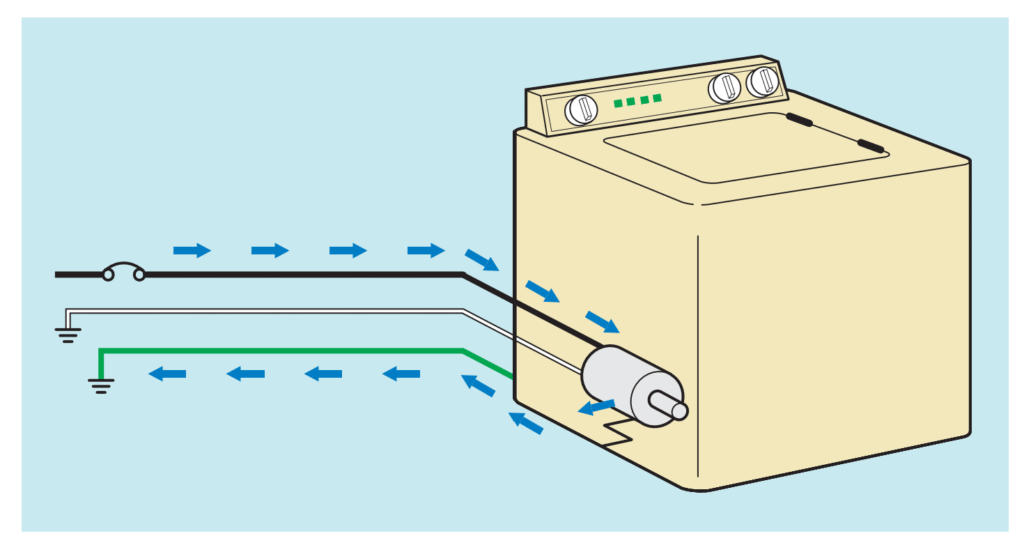
Without a grounding conductor connected to the frame of the appliance, the frame would become hot (in the electrical sense) and anyone touching the case and a grounded point, such as a water line, would complete the circuit to ground. The resulting shock could be fatal. For this reason, the grounding prong of a plug should never be cut off or bypassed.


